

PSAT/SAT EXAM PREP
The SAT remains an important part of the college admissions process and an opportunity for students to demonstrate their academic readiness. Today’s Digital SAT requires more than simply knowing the material—students must also develop strong test-taking strategies, time management skills, and confidence under pressure.
At DIM, we prepare students for every aspect of the Digital SAT. Our program strengthens the essential skills tested in Reading & Writing and Math while teaching students how to approach the SAT’s adaptive format effectively. Through targeted instruction, proven testing strategies, realistic practice, and regular mock exams, students learn how to identify their weaknesses, improve their accuracy and efficiency, and approach test day with confidence.
Our goal is not simply to help students practice more questions. We help students understand the test, develop an effective strategy, and build the skills and confidence necessary to achieve their best possible score.
-
Our Summer SAT Intensive is designed to prepare students for the August SAT, combining focused instruction, test-taking strategies, and regular practice throughout the summer. The program is an excellent fit for rising juniors and seniors looking to achieve their target scores before the school year begins and college application season gets underway.
Freshmen and sophomores are also welcome and can benefit greatly from early exposure to SAT concepts, strategies, and the Digital SAT format. Starting early allows younger students to strengthen their academic foundations and develop valuable testing skills well before their official exam.
-
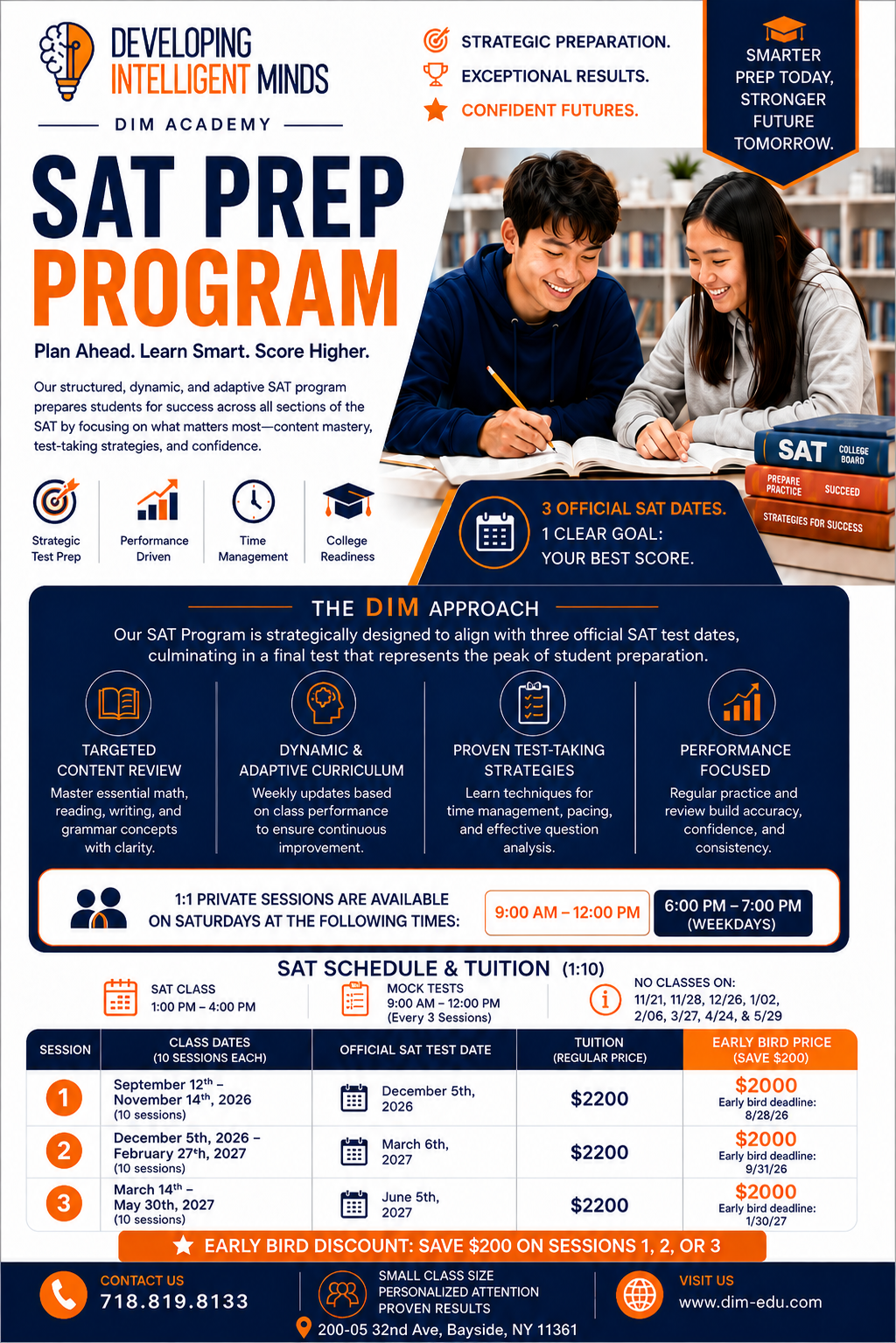
Our School Year Saturday SAT Program is divided into three sessions, with each session designed to prepare students for the December, March, and June SAT exams, respectively. This structure allows students to select the testing timeline that best fits their academic and college planning goals.
The program is a great choice for students preparing for their first official SAT, seniors looking for a final opportunity to improve their scores before application deadlines, and younger students who want early exposure to the SAT. Through consistent Saturday instruction and practice, students build the skills, strategies, and familiarity needed to approach the Digital SAT with confidence.
-
Our Weekday SAT Tutoring provides personalized instruction in either a 1-on-1 or 1-on-2 setting, allowing lessons to be tailored to each student's individual strengths, weaknesses, and target score.
This option is especially beneficial for students preparing for an SAT test date not covered by our regular Summer or Saturday programs, or for those seeking more individualized support to achieve significant score improvement. With focused instruction, targeted practice, and personalized test strategies, students can concentrate their time on the areas where they have the greatest opportunity for improvement.

What’s on the test?
SAT ENGLISH
The Reading and Writing section consists of 54 multiple-choice questions divided into two 32-minute modules. Rather than answering several questions based on long reading passages, students work with short passages—typically ranging from 25 to 150 words—with one question per passage. The section assesses reading comprehension, vocabulary in context, analysis and reasoning, rhetorical skills, and Standard English grammar and conventions.
SAT MATH
Questions on the SAT Math section are distributed across four major content areas: Algebra, Advanced Math, Problem-Solving and Data Analysis, and Geometry and Trigonometry. Of the 44 total Math questions, approximately 13–15 questions focus on Algebra, 13–15 on Advanced Math, 5–7 on Problem-Solving and Data Analysis, and 5–7 on Geometry and Trigonometry.
PROVEN RESULTS
Our SAT team has years of experience teaching the ins and outs of the SAT exam. Our curriculum is focused on teaching your child the core concepts that they need in order to answer the questions both effectively and efficiently.
Upcoming Test Dates
| SAT Test Date | Registration Deadline | Deadline for Regular Cancellation |
|---|---|---|
| September 12, 2026 | August 28, 2026 | September 1, 2026 |
| October 3, 2026 | September 18, 2026 | September 22, 2026 |
| November 7, 2026 | October 23, 2026 | October 27, 2026 |
| December 5, 2026 | November 20, 2026 | November 24, 2026 |
| March 6, 2027 | February 19, 2027 | February 23, 2027 |
| May 1, 2027 | April 16, 2027 | April 20, 2027 |
| June 5, 2027 | May 21, 2027 | May 25, 2027 |
7 Week Summer Program:
July 6th, 2026 - August 21st 2026
| Program | Description | Scheduled Days | Time | Mock Exam | Price | Early Bird |
|---|---|---|---|---|---|---|
| SAT Summer Course | Dedicated to all students, especially those taking the SAT on August 22nd 2026. | Monday - Friday |
9:00 AM - 12:00 PM |
Thursdays 9:00 AM -12 PM |
$3300.00 | $2800.00 |
Session 1: 10 Classes - no class 11/21, 11/28
September 12th, 2026 - November 14th 2026
| Program | Description | Scheduled Days | Time | Mock Exam | Price | Early Bird |
|---|---|---|---|---|---|---|
| Session 1 | Geared towards student looking to take the December 5th SAT. | Saturdays | 1:00 PM - 4:00 PM |
Every ~3 sessions: Saturdays 9:00 AM -12 PM |
$2200.00 | $2000.00 by 8/28/2026 |
Session 2: 10 Classes - no class 12/26, 01/02/27, 02/06/27
December 5th, 2026 - February 27th 2027
| Program | Description | Scheduled Days | Time | Mock Exam | Price | Early Bird |
|---|---|---|---|---|---|---|
| Session 2 | Geared towards student looking to take the March 5th SAT. | Saturdays | 1:00 PM - 4:00 PM |
Every ~3 sessions: Saturdays 9:00 AM -12 PM |
$2200.00 | $2000.00 by 9/31/2026 |
Session 3: 10 Classes - no class 3/27, 4/24, 5/29
March 14th, 2027 - May 30th, 2027
| Program | Description | Scheduled Days | Time | Mock Exam | Price | Early Bird |
|---|---|---|---|---|---|---|
| Session 3 | Geared towards student looking to take the June 5th SAT. | Saturdays | 1:00 PM - 4:00 PM |
Every ~3 sessions: Saturdays 9:00 AM -12 PM |
$2200.00 | $2000.00 by 1/30/2027 |
Curriculum
SAT MATH
Our SAT Math program takes a practical and strategy-driven approach to the Digital SAT. In addition to building a strong mathematical foundation, we teach students how to solve problems efficiently, manage their time effectively, and recognize the fastest approach to each question. Students also learn how to make effective use of the SAT’s built-in Desmos calculator, including when calculator use can save time and when solving a problem by hand may be faster.
Our curriculum covers all four major areas of SAT Math:
Algebra – linear equations, linear functions, systems of equations, and inequalities
Advanced Math – quadratics, exponentials, polynomials, radicals, rational expressions, nonlinear equations, and functions
Problem-Solving & Data Analysis – ratios, rates, percentages, statistics, probability, data interpretation, and scatterplots
Geometry & Trigonometry – area and volume, angles and triangles, circles, right triangles, and trigonometry
Through targeted practice, students develop not only the mathematical knowledge required for the SAT, but also the speed, accuracy, calculator proficiency, and test-taking judgment needed to maximize their performance.
SAT READING
Our SAT Reading & Writing program takes a strategic, skill-based approach to the Digital SAT. We begin by emphasizing grammar and vocabulary, where students can often make the quickest and most consistent gains. Students develop a strong command of sentence structure, punctuation, usage, transitions, and vocabulary in context while learning to recognize common question patterns and eliminate incorrect answer choices efficiently.
Once these foundational skills are established, we delve deeper into reading comprehension and critical reasoning. Rather than relying solely on general reading ability, students learn a structured decision-making process for approaching passages, identifying relevant evidence, and distinguishing between answers that are merely plausible and those that are fully supported by the text.
Our curriculum focuses on:
Grammar & Standard English Conventions – sentence structure, punctuation, usage, agreement, modifiers, and sentence boundaries
Vocabulary in Context – determining precise word meanings using context, tone, and textual clues
Reading Comprehension – central ideas, details, text structure, and author purpose
Inference & Deduction – drawing logical conclusions from stated and implied information
Command of Evidence – identifying the textual or quantitative evidence that best supports a conclusion
Rhetorical Skills – transitions, organization, synthesis, and effective expression of ideas
Decision-Making & Test Strategy – eliminating unsupported choices, recognizing common traps, managing time, and selecting the answer best supported by the passage
Our goal is to help students move beyond simply “understanding” a passage. Students learn to reason from evidence, make disciplined decisions, and approach each question with a repeatable strategy, allowing them to improve both their accuracy and efficiency on the SAT.
Mock Exams
Regular mock exams are an essential part of our SAT program. Students practice using digital versions of the SAT to become comfortable with the format, pacing, tools, and overall testing experience they will encounter on their official exam.
In addition to realistic SAT simulations, our mock exams are intentionally slightly longer and more demanding than the official test. This gives students greater exposure to SAT-style questions while helping them build the endurance, concentration, and time-management skills necessary to perform consistently from beginning to end.
Mock exams also allow us to track each student's progress and identify areas that require additional preparation. Following each exam, students receive a personalized performance report highlighting their strengths, weaknesses, and areas of improvement, allowing instruction and practice to be targeted toward the skills that will have the greatest impact on their scores.
Frequently Asked Questions
-
The PSAT and SAT test very similar Reading, Writing, and Math skills, but they serve different purposes. The PSAT is primarily a practice and assessment exam that helps students understand their current level and prepare for the SAT. For juniors, the PSAT/NMSQT can also be used to qualify for the National Merit Scholarship Program.
The SAT is an official college admissions exam. Students can choose to submit their SAT scores to colleges as part of the application process.
Because the two exams cover very similar skills and use similar digital formats, preparing for the SAT also prepares students for the PSAT. The PSAT is slightly shorter and has a different scoring scale, but the strategies and academic skills needed for both tests are largely the same.
-
Students can take the PSAT more than once during high school, depending on their school’s testing schedule. Many students take it in 10th grade for practice and again in 11th grade.
The junior-year PSAT/NMSQT is the most important, as it is the attempt that can qualify eligible students for the National Merit Scholarship Program. Earlier PSAT exams are excellent opportunities to gain testing experience, identify strengths and weaknesses, and prepare for both the junior-year PSAT and the SAT.
You can take the SAT as many times as you would like—there is no official limit. However, we generally recommend that students take the SAT no more than three times. Ideally, each attempt should have a purpose, with sufficient preparation and improvement between test dates. Taking the exam repeatedly without addressing weaknesses is unlikely to produce meaningful gains.
For most students, two to three well-prepared attempts provide enough opportunities to improve their scores and take advantage of superscoring while avoiding unnecessary testing.
-
We generally recommend that students take the PSAT in 10th grade for practice and again in 11th grade, when the PSAT/NMSQT can qualify eligible students for the National Merit Scholarship Program.
Taking the PSAT as a sophomore gives students an opportunity to become familiar with the test, identify strengths and weaknesses, and determine what they should work on before junior year. By 11th grade, students should approach the PSAT more seriously and prepare in advance, especially if National Merit recognition is a goal.
The PSAT/NMSQT is typically administered by schools in October, and registration is generally handled through the student's high school.
We generally recommend taking your first SAT during the spring of your junior year, typically in March, May, or June. By this point, students have completed most of the coursework covered on the SAT while still having plenty of time to identify weaknesses and improve.
Students who want to improve their scores can then prepare for a second attempt in August, September, or October, before most senior-year college application deadlines.
Ideally, students should begin preparing several months before their first official SAT rather than waiting until senior year. This provides enough time to build the necessary skills, become comfortable with the Digital SAT, and make meaningful improvements between attempts.
-
A “good” SAT score depends on the colleges you are considering. Rather than focusing on one universal target, students should research the typical SAT score ranges of the schools on their college list and set a goal accordingly.
For more selective universities, students should generally aim to score within or above the middle 50% SAT range of admitted students. We help students establish a realistic target score based on their starting point, college goals, and available preparation time.
-
Most students should plan to prepare for the SAT for approximately 2–4 months before their official test. However, preparation time depends on a student's starting score, target score, academic foundation, and weekly study schedule.
Students seeking significant score improvements may benefit from starting earlier. Consistent, focused preparation over time is generally more effective than trying to study everything in the weeks immediately before the exam.
-
Students can register for the SAT online through the College Board website. You will need to create or sign in to your College Board account, select your preferred test date and testing location, provide the required personal information and photo, and complete the registration and payment process.
We recommend registering as early as possible, as nearby testing centers can fill up quickly. After registering, students should also download the Bluebook testing application and complete the required exam setup before test day.
Important: Students must register for themselves using their own College Board account; a parent or counselor cannot complete the registration on their behalf.
Register for the SAT HERE
Visit Us
200-05 32nd Avenue, Bayside, NY 11361
Email: info@dim-edu.com
Phone: (516)-418-2534
Hours
Sunday: closed
Monday: 2:00 pm – 6:00 pm
Tuesday: 2:00 pm – 6:00 pm
Wednesday: 2:00 pm – 6:00 pm
Thursday: 2:00 pm – 6:00 pm
Friday: 2:00 pm – 6:00 pm
Saturday: 9:00 am - 4:00 pm